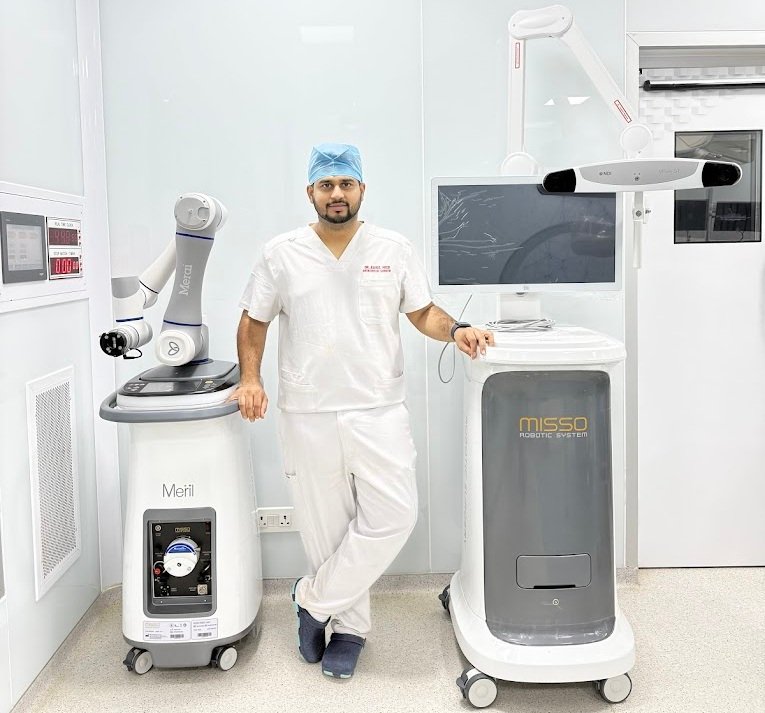
As a medical journalist, I often visit operating theatres and outpatient clinics to understand how evolving technologies translate into real-world patient care. During a recent visit to Kapadia Multispeciality Hospital in Goregaon West, Mumbai, I met Dr. Rahul Modi to discuss Robotic Knee Replacement in Mumbai—a procedure that has gained attention for its precision-driven approach to managing advanced knee arthritis. The conversation focused not on technology hype, but on patient selection, surgical planning, and long-term recovery.
Professional Qualifications and Orthopedic Training of Dr. Rahul Modi
Dr. Rahul Modi’s qualifications reflect a formal and structured journey through orthopedic education and clinical training. As detailed in his professional profile, he completed his medical education followed by specialization in orthopedics, with focused training in joint replacement and trauma care. Over the years, he has continued to expand his expertise through hands-on surgical practice and exposure to evolving orthopedic techniques.
Recognised as an Orthopedic Surgeon in Mumbai, Dr. Rahul Modi’s work spans knee replacement surgery, trauma management, and degenerative joint conditions. His practice as an Orthopedic surgeon in Goregaon places him at the intersection of high patient volume and diverse orthopedic presentations, shaping a pragmatic and experience-led approach to care.
Clinical Experience and Focus on Knee Replacement Surgery
Dr. Rahul Modi’s clinical experience includes managing patients with varying degrees of knee osteoarthritis, deformity, and mobility limitations. During our interview, he explained that robotic-assisted knee replacement is typically considered when conservative treatments—such as medication, physiotherapy, or injections—no longer provide relief.
His experience with robotic systems is grounded in conventional knee replacement principles, with technology used to enhance planning and execution rather than replace surgical judgment. This balance, he noted, is essential for consistent outcomes across different patient profiles.
Inside Kapadia Multispeciality Hospital: Clinic Environment and Setup
Kapadia Multispeciality Hospital offers a clinical environment designed to support both complex surgeries and structured rehabilitation. The hospital features dedicated operation theatres, imaging facilities, and physiotherapy support, allowing continuity of care from diagnosis through recovery.
From an observer’s perspective, the setup encourages multidisciplinary collaboration. Dr. Rahul Modi highlighted that knee replacement outcomes depend not only on surgery, but also on anesthesia management, nursing care, and post-operative physiotherapy—all of which are integrated within the hospital framework.
Understanding Robotic Knee Replacement in Mumbai
When discussing Robotic Knee Replacement in Mumbai, Dr. Rahul Modi clarified that robotic systems assist surgeons by creating a personalized surgical plan using pre-operative imaging and intra-operative data. The robot provides real-time feedback to help achieve accurate bone cuts and implant alignment.
He emphasized that the robot does not perform surgery independently. Instead, it functions as a tool that supports the surgeon’s decisions, potentially improving consistency and alignment accuracy—factors linked to joint function and implant longevity.
Benefits and Risks: A Balanced Clinical Perspective
Dr. Rahul Modi approached the benefits and risks of Robotic Knee Replacement in Mumbai with measured clarity, stressing that technology does not eliminate the fundamentals of surgery.
Potential Benefits:
- More precise implant positioning
- Improved alignment tailored to patient anatomy
- Reduced soft tissue disruption
- Potential for smoother post-operative mobility
Recognised Risks and Considerations:
- Infection or blood clot risk, as with any major surgery
- Post-operative pain or stiffness during recovery
- Implant-related complications in rare cases
- Dependence on rehabilitation for functional success
He underscored that outcomes vary based on patient health, adherence to physiotherapy, and realistic expectations.
Approximate Cost Range: A Neutral Overview
On the subject of cost, Dr. Rahul Modi explained that robotic-assisted knee replacement generally involves higher expenses than conventional procedures due to advanced equipment and planning systems. Costs vary depending on implant choice, hospital stay, and individual medical needs.
In broad terms, patients may encounter costs in the higher six-figure range in Indian rupees. He advised that detailed cost discussions should follow clinical evaluation rather than assumptions, ensuring transparency and appropriateness of care.
Precautions and Aftercare: Advice Shared During the Interview
Aftercare formed a significant part of our discussion. Dr. Rahul Modi outlined several precautions and recovery principles commonly shared with patients:
- Early mobilization under supervision
- Structured physiotherapy to restore strength and motion
- Adherence to medication and wound-care instructions
- Monitoring for signs of infection or complications
- Gradual return to daily activities based on progress
From a journalistic standpoint, it was clear that post-operative discipline plays a decisive role in long-term outcomes.
Ethical Considerations in Technology-Assisted Surgery
Throughout the interview, Dr. Rahul Modi emphasized ethical responsibility in adopting new technology. As an Orthopedic Surgeon in Mumbai, he believes robotic assistance should be used where it adds value—not as a default option for every patient. Careful selection and patient education remain central to responsible orthopedic practice.
A Journalist’s Closing Reflection
My visit to Kapadia Multispeciality Hospital offered a grounded view of how robotic technology is integrated into orthopedic care when guided by clinical judgment rather than novelty. Speaking with Dr. Rahul Modi highlighted the importance of balancing innovation with patient-centered decision-making.
Serving you from Goregaon West, Mumbai.
Have a query or want to schedule a consultation? We are just a call away.
📞 +91 77770 45206 / +91 73049 97815
📧 dr.rahulrmodi@gmail.com
Get Directions to the Clinic: Kapadia Multispeciality Hospital, Goregaon West, Mumbai.